
Most families don't plan to talk about aging. Then a phone call comes. Mom fell. Dad is in the hospital. Someone needs to make decisions, pay bills, and talk to doctors, and no one is quite sure what Mom or Dad would want, where the paperwork is, or who has the authority to act.
Estate planning attorneys have a saying for this:
"It never happens until it does."
That is why these conversations matter. Families often wait until a fall, a diagnosis, or a hospital stay. By then, the person you love may not be able to tell you what they want. And you may not have the legal authority, passwords, or paperwork to help them.
You are not alone in this. According to AARP and the National Alliance for Caregiving, 63 million Americans are now family caregivers, roughly 1 in 4 adults. When we polled attendees at a recent Forty W Advisors financial wellness webinar on this topic, two-thirds said they expect to become a caregiver.
This guide breaks the conversation into four parts:
1. Estate planning documents and the people named in them
2. Financial accounts, assets, titling, and beneficiaries
3. Health care wishes and living arrangements
4. Building a care team with siblings and other loved ones
You do not need to cover all of it in one sitting. In fact, you shouldn't.
Why Start the Conversation Now
It is easier to talk while your parents are healthy, sharp, and still in charge of their own lives. As people age, communication can get harder for physical reasons (a stroke, hearing loss, being on a ventilator), mental reasons (memory loss or dementia), or emotional ones (pulling back and shutting out help).
Here's a point that surprises many families: in some ways, it is harder to help someone who is still alive than to settle their affairs after they pass. When a parent is living but can't make decisions, banks, doctors, and other providers will only work with someone who has the right legal authority.
And having the right documents is only half the job. A parent can name a health care agent and still leave that person guessing if they never talked about what they actually want.
How to Bring It Up Without a Fight
Many parents push back when their adult children seem to be taking charge. "You're not the boss of me" is a common response. A few approaches that work better:
· Say "I feel," not "You should." "You need to stop driving" puts a parent on the defensive. "I worry every time you drive at night, and I can't sleep until I know you're home" invites a conversation. Sharing your worry lands differently than giving orders.
· Use a conversation starter. A news story, a neighbor's experience, or an article (like AARP's guide to preparing a digital estate plan) gives you a natural way in: "I read this and it made me wonder, have you thought about this?"
· Bring in a third party. "Our financial advisor suggested we talk about this" takes some of the emotional baggage out of the room. A neutral professional can also help keep things calm and on track when siblings see things differently.
· Remind them you can't read minds. Try: "We love you, and we want to honor what you want. But we can only do that if you tell us."
Part 1: Estate Planning Conversations
Many parents will tell you, "Don't worry, we have a will." That's a great start, but it isn't the finish line. The documents are only as good as the people named in them. Those people need to know they've been named, understand the job, and be able to do it.
The Key Roles, in Plain English
Executor (called a "personal representative" in Maryland and some other states). This is the person named in a will to settle the estate after death. The job can include finding the will, working with the probate court, notifying beneficiaries and creditors, collecting and valuing assets, paying debts and taxes, and handing out what's left. Nolo's executor checklist notes that probate commonly takes about a year, so this is a real commitment.
Trustee. If your parent has a living trust, the trustee holds and manages the trust's property and distributes it according to the trust's instructions. The National Institute on Aging describes a living trust as naming a person "to hold and distribute property and funds on your behalf when you are no longer able to manage your affairs." Many parents serve as their own trustee and name a successor trustee to step in if they become unable to manage things or pass away.
Financial power of attorney. This document names an "agent" to make financial decisions if your parent can't, according to the National Institute on Aging. Think paying bills, managing accounts, filing taxes, and dealing with insurance. One detail many families miss: a power of attorney works only while your parent is alive. At death, that authority ends and the executor takes over.
Health care power of attorney (also called a health care proxy or agent). This person makes medical decisions if your parent can't speak for themselves. The National Institute on Aging stresses that this person should know your parent's values and wishes. It often works alongside a living will, which spells out the treatments your parent does or does not want. A HIPAA authorization lets doctors share medical information with the people your parent names. AARP notes that having both a proxy and a HIPAA authorization can help avoid delays.
Questions to Review Together
When you look at the documents with your parents, go beyond "do they exist?" Ask:
· Do the people named know they've been named? A decision-maker who has never discussed your parent's wishes is left to guess at the worst possible moment.
· Are they still the right people? People move away, get sick, divorce, or pass away. A document signed 20 years ago may name someone who no longer makes sense.
· Can they actually do the job? Consider where they live, their health, how organized they are, how comfortable they are with money, and how well they work with the rest of the family.
· Is there a backup? The person best suited for the role today may face their own health issue, move, or simply burn out. Naming a successor keeps the plan working.
· Where are the originals? The National Institute on Aging recommends keeping important papers together and making sure someone you trust knows where to find them.
· Do the documents cover digital assets? AARP's digital estate planning guide recommends that wills, powers of attorney, and trusts give someone authority over online accounts and devices.
If anything is out of date, unclear, or missing, then your parents' will want to update their documents. As part of our client services, we use an estate-planning platform to help make this part of our client’s financial life easier to organize, update and follow through on. The platform provides a structured way to create and update documents at no additional cost, it provides meaningful presentations that can be used to help communicate the estate plan to other and helps us coordinate the estate plan with clients broader financial picture.
Part 2: Understanding the Financial Picture
This is one of the most common tensions we see. Parents say, "I don't want my kids to know what I have." Kids say, "My parents won't tell me anything, and I don't know their passwords."
Here's the reality:
You don't need to know all the details. You need to know where it is, so that when you need it, you have it.
The National Institute on Aging puts it the same way: "You don't need to discuss your personal affairs, but someone you trust should know where to find your papers in case of an emergency."
What to Inventory
Start with a simple list of where things are and who to call:
· Bank and credit union accounts (checking, savings, CDs)
· Investment and brokerage accounts
· Retirement accounts (401(k)s, 403(b)s, IRAs, pensions)
· Annuities and life insurance, with policy numbers and agent contacts
· Income sources (Social Security, pensions, required minimum distributions, rental income)
· Real estate, deeds, and mortgages
· Debts and recurring bills, including property taxes, HOA or community fees, and insurance premiums
· A safe deposit box: where it is, where the key is, and who is authorized to open it
· Digital assets: email, online banking, social media, photos, subscriptions, and cryptocurrency
· Key contacts: attorney, CPA, financial advisor, and insurance agents
Digital assets deserve special attention. AARP reports that 1 in 3 caregivers say finding passwords and accounts is a top challenge, and 49 percent don't have legal permission to ask providers for access. A password manager and tools like Apple's Legacy Contact can help. AARP also warns never to put passwords in a will, since wills can become public record in probate.
Don't forget the small things. If a parent goes from the hospital to rehab, who is caring for the pets? Who is watching the house? Who is paying the community fee, even if the mortgage is paid off? Most families don't think of these questions until they're in the middle of a crisis.
Titling: Who Owns What, and How
How an account is titled decides who can access it and what happens to it. Common examples:
· Individual: owned by one person
· Joint with right of survivorship: passes to the surviving owner
· Transfer-on-death (TOD) or payable-on-death (POD): passes directly to a named person
· Trust-owned: managed by the trustee under the trust's terms
Titling also affects the plan. A living trust works best when assets are actually retitled into it. And adding a child to an account as a joint owner may seem convenient, but it can create tax, creditor, and fairness issues between siblings. Talk to your advisor and attorney before making changes.
Beneficiaries: The Forms That Outrank the Will
For retirement accounts, annuities, and life insurance, the beneficiary form usually controls who inherits, not the will. As one CFP and attorney told Investopedia, "Beneficiary forms are extremely powerful and trump whatever it might say in the will in most or all circumstances."
That can lead to painful surprises. KWQC reported on how a 401(k) can still pay an ex-spouse if the paperwork was never updated after a divorce. And if no beneficiary is named, the account may fall into the estate and go through probate, according to Regions.
As part of your review, confirm for each account:
· Who is the primary beneficiary?
· Who is the contingent (backup) beneficiary?
· Do the forms line up with the will and trust?
· Have they been updated after marriages, divorces, births, and deaths?
Keep It All in One Place
Our client portal can bring a family's financial picture into one view, so the right family members know which institutions hold which accounts. Its secure vault can also store copies of wills, trusts, powers of attorney, medical directives, and HIPAA authorizations. If your parents prefer paper, an organized physical file stored in a home safe, a safe deposit box, or with an attorney works too. The format matters less than the result: one place, and the right people know where it is.
Part 3: Health Care Wishes as They Age
Money and documents are only part of the picture. The other part is what your parents want their lives to look like as their health changes.
Know the Care Team
Make a simple list of:
· Primary care doctor and specialists
· Pharmacy and current medications
· Medicare, supplemental, and prescription drug plans (and who reviews them each year during open enrollment)
· Hospital preference
· Who has HIPAA authorization or patient portal access
Where Do They Want to Live?
This is often the biggest question. Do your parents want to age in place at home? Would they consider independent living, assisted living, or memory care if needed? Is there a community or location they prefer, perhaps near a certain child?
Knowing the answer early gives you time to prepare. If a parent wants to stay home, the family can plan ahead for safety changes and line up aides, drivers, or meal help before there's a crisis. If a move may be needed, siblings can research and tour options now, instead of choosing in a rush after a hospital discharge.
Talk About the Hard Stuff, Too
Five Wishes is a helpful tool. It's an advance directive that covers who should make decisions, which treatments a person wants or doesn't want, physical comfort, spiritual comfort, and what they want loved ones to know. One idea: fill it out yourself first, then share it with your parents. It turns a hard conversation into a shared exercise rather than a test.
Final wishes count, too. Does your parent want a burial or cremation? A religious service or a celebration of life? Without that conversation, a grieving family can spend thousands of dollars on a funeral and still not do what their loved one wanted.
For more conversation prompts, The Conversation Project offers free guides on starting the conversation, choosing a health care proxy, and being one.
Part 4: Building a Care Team With Siblings and Loved Ones
Caregiving is a team sport. When one person carries it all, burnout follows. The AARP and National Alliance for Caregiving report found that 23 percent of caregivers have taken on debt and 20 percent report fair or poor health tied to their caregiving.
Everyone Can Help
Not everyone can provide hands-on care, and that's okay. Often the sibling who lives closest handles doctor visits and day-to-day needs. A sibling who lives far away can still manage bill paying, insurance, or technology remotely. A sibling with a demanding job may be able to help pay for care. Every one of those roles counts.
Ways to contribute include:
· Scheduling appointments
· Doing research on care options, providers, or benefits
· Sending money
· Calling for follow-up reports from doctors or facilities
· Visiting to give the main caregiver a break
Divide the Work by Area
Group the work into five areas and pick one point person for each:
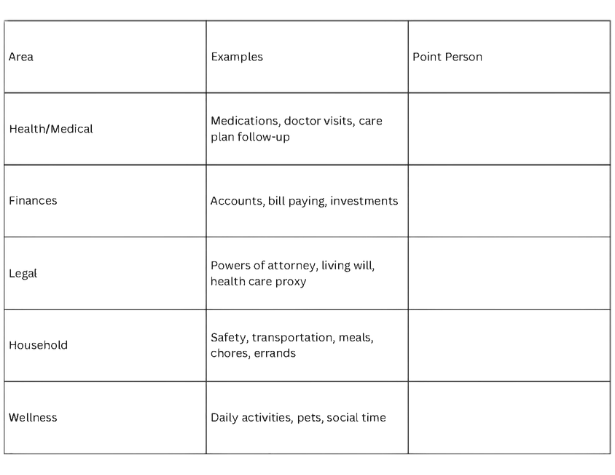
Where family can't fill a role, bring in friends, neighbors, faith communities, and professionals: doctors, therapists, elder care attorneys, accountants, financial planners, home aides, and drivers. Decide who will coordinate those experts and follow up on what they recommend.
Hold a Family Meeting
The Family Caregiver Alliance offers a practical guide to family meetings. A few highlights:
· Send an agenda ahead of time so everyone can add topics.
· Include people who can't travel by phone or video.
· Give everyone a chance to speak, and use "I need" instead of "You should."
· Focus on caring for your parent, not settling old family disputes.
· Write down who agreed to do what, and schedule the next meeting.
· Consider a neutral facilitator if the conversation is likely to get heated.
Don't Be a "Seagull"
The Conversation Project describes the "seagull": the out-of-town sibling who swoops in, assumes they know best, and upends the plan the local caregiver has built. If you live far away, listen first, ask how you can help, and make it clear you're on the same team.
Share Updates and Share Your Own Wishes
None of us are mind readers. Team members need to keep each other updated on how their parent is doing. A shared group text, email thread, or calendar can keep everyone informed.
And when there's a disagreement, it helps to point back to what your parent actually said. "Mom told us this. Remember that conversation?" settles far more than "I think she'd want this."
One more thing. While you're asking your parents to share their wishes, share your own. Your kids and loved ones will one day need the same information from you.
Take Care of Yourself
A few ways to reduce stress: prepare before you need to, build your support team, accept help from others, communicate often, and most important, take care of yourself. AARP's caregiving resources are a good place to start.
Knowing You're Doing What They Want Means Less Stress
At Forty W Advisors, our goal is to help clients get more time and less stress. Caregiving can take a huge amount of both. The families who handle it best usually follow three steps:
1. Start the conversation early, while your parents can tell you what they want.
2. Identify the needs and make a plan, covering documents, finances, health care, and living arrangements.
3. Build a team so no one carries the load alone.
You don't have to do it all at once. Start small. Holidays, birthdays, and family visits are natural times to say, "We'd love to get some of this organized. Can we set up a time to talk?"
Want help getting started? Our team can help you review documents, organize financial information, and guide a family conversation. Schedule a family planning conversation.
Helpful Resources
· The Conversation Project: Conversation and Health Care Proxy Guides — free guides for talking about care wishes
· National Institute on Aging: Getting Your Affairs in Order Checklist — a list of personal, financial, and legal records to gather
· Five Wishes — an advance directive that covers medical, personal, and spiritual wishes
· AARP: Prepare a Digital Estate Plan for Future Caregivers — how to plan for online accounts and devices
· Family Caregiver Alliance: Holding a Family Meeting — a step-by-step guide for sibling and family meetings
· The Conversation Project: How Not to Be a Swooper — advice for long-distance siblings and primary caregivers
This article is for educational and informational purposes only and should not be considered legal, tax, or investment advice. Estate planning laws vary by state. Please consult your attorney, tax professional, or financial advisor about your specific situation.
All investments contain risk and may lose value. Past performance is not an indication of future performance. Information contained herein has been obtained from sources believed to be reliable but not guaranteed. This material has been distributed for informational purposes only and should not be considered as investment advice or a recommendation of any particular security, strategy or investment product.