
Q3 2026 - Market Commentary
Last Call? What’s Fueling the Party, What Could End It, and Why Diversification Matters
The economy spent the third quarter getting hit with higher oil prices, rising interest rates and a Federal Reserve rate hike, and it shrugged them off. Oil traded back above $100 a barrel, the Fed raised rates 0.25% in September for the first time since 2023, and the 10-year Treasury yield rose more than 0.80% in the quarter. Yet the S&P 500 still closed at a new all-time high. Two big spenders explain why: technology companies building out artificial intelligence, and American consumers.
This article looks at what is keeping the party going, what could end it, why growth is likely to cool, and why diversification matters more than usual right now.
1. Looking back: the same drivers keep chugging along
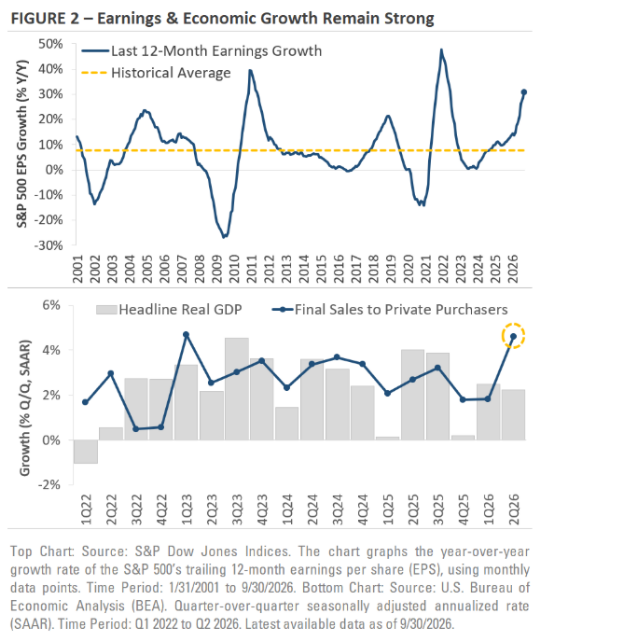
The forces that powered markets last year are still doing the heavy lifting, and so far they have out-muscled worries about rates and oil. S&P 500 company trailing 12-month earnings grew nearly 30% over the past year, one of the strongest stretches since 2001 outside the post-financial crisis and post-COVID rebounds. The support for earnings has been continued spending by businesses building out their AI infrastructure and consumers.
On the economic front, underneath a modest 2.2% headline GDP print in Q2, final sales to private purchasers, a measure of consumer spending and business investment, grew at a 4.6% annualized. This illustrates the influence business and consumer spending has on the overall economy. (See Figure 2)
Hyperscalers are still pouring
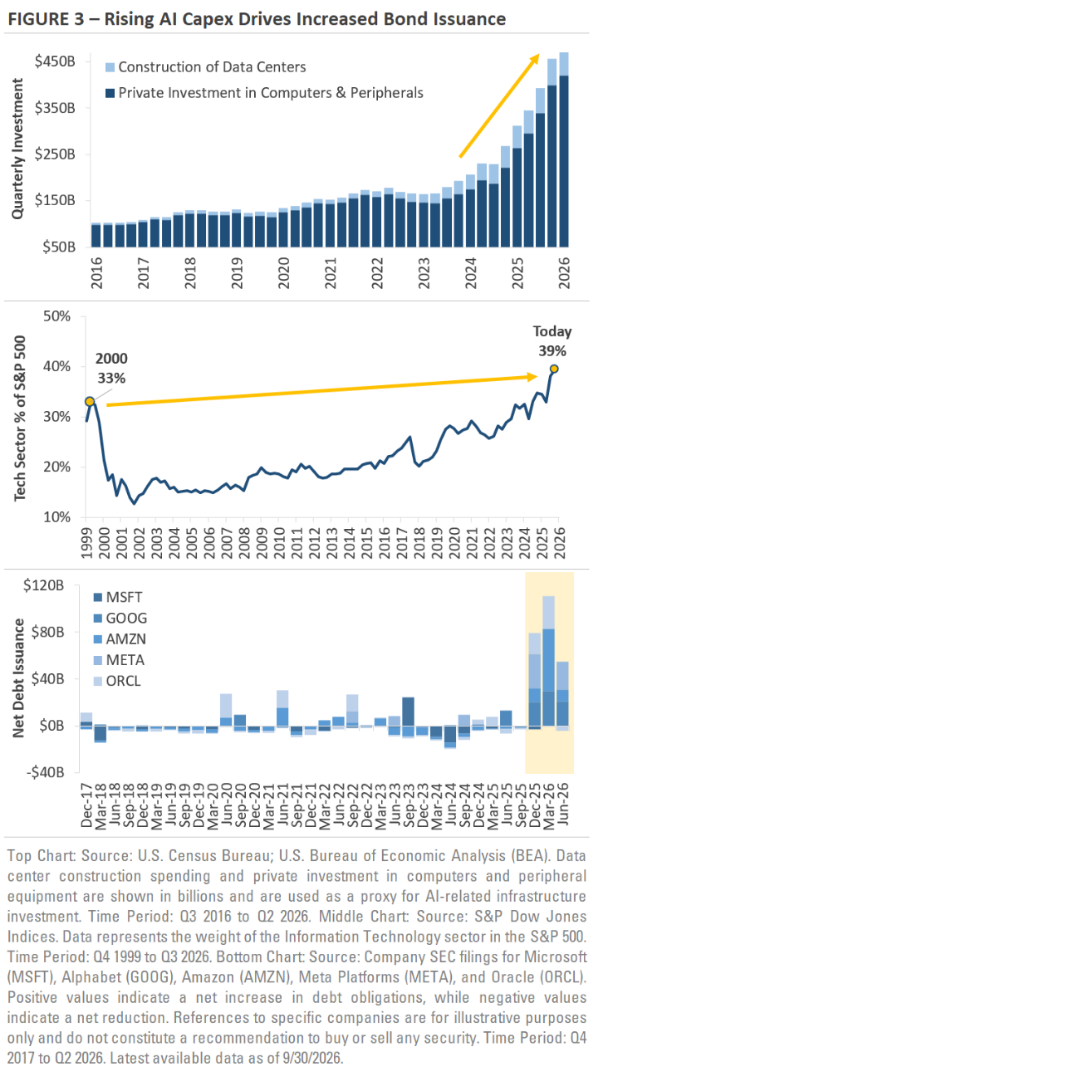
AI spending is the single biggest engine of business investment. Spending on data-center construction and computer equipment, a proxy for AI infrastructure, has grown from roughly $180 billion at the end of 2023 to nearly $490 billion today (US Census Bureau, US BEA). The four largest cloud and platform companies (Amazon, Microsoft, Alphabet and Meta) are on track to spend about $725 billion on capital projects in 2026, up 77% from about $410 billion last year, and some analysts already model more than $1 trillion for 2027 (AI Weekly, citing the Financial Times).
The top five contributors to S&P 500 earnings growth in Q2 were Alphabet, Amazon, Micron, NVIDIA and Chevron: four AI names and one oil producer (FactSet). Something most investors don’t realize is that an investment in the S&P 500 imbeds an investment into some of the private AI models that are quickly becoming a part of everyday life. The index’s Q2 earnings growth of 50.4% included a $98 billion gain on equity holdings at Alphabet and a $53.4 billion gain at Amazon tied mostly to its investment in Anthropic. Excluding those two companies, growth falls to 32.0% (FactSet).
Consumers at the open bar
Consumers are spending like wedding guests at an open bar, despite consumer prices rising 3.4% from a year earlier.
The guests drinking most freely are the wealthy. The top 10% of earners accounted for 49.2% of consumer spending, the highest share in data back to 1989, while spending by the bottom 80% has merely kept pace with inflation since the pandemic (NewsNation/Moody’s Analytics).
2. What can stop the party
Parties end when the guests have had too much to drink. For this economy, that means the day businesses and consumers slow their spending, whether by choice or because markets force their hand.
Big Tech is now borrowing to keep the bar open
The largest technology companies remain highly profitable, but their AI programs have grown so fast that they are turning to the bond market. Historically this group balanced new borrowing against paying down debt; recently, new issuance has jumped sharply (Figure 3). Alphabet, Meta, Amazon and Oracle alone have issued more than $300 billion of bonds since the start of 2025 (Fortune). S&P Global Ratings estimates that the five largest AI spenders will put about $750 billion into capital projects this year, equal to 38% of their combined revenue (MLQ.ai, citing Reuters).
The strain is already showing in cash flow. Analysts at Morgan Stanley projected Amazon would run negative free cash flow of almost $17 billion in 2026, and Barclays projected Meta’s free cash flow would fall nearly 90% (CNBC). Lenders are getting pickier too. Demand for hyperscaler bond deals, measured by orders relative to bonds offered, fell from nearly 5 times in February to below 2 times in July, and Amazon had to pay extra yield to place a $25 billion offering (Fortune).
In the coming months and years, these companies will have to show investors that the spending turns into real profits. At some point, attention will shift from how much is being spent on AI to what that spending produces in revenue, profits and productivity. If investors start to doubt future earnings, they will force a pullback the old-fashioned way: by driving down stock prices and raising borrowing costs until spending plans shrink. Any hint that returns are falling short could set that in motion quickly.
The wealth effect cuts both ways
Wealthier consumers are spending because they feel rich, and on paper they are. Household net worth rose a record $12.8 trillion in Q2 to $196 trillion, powered mainly by stock prices (KPMG). Because the top 10% of earners now drive about half of all spending, the economy depends heavily on those portfolios continuing to rise.
That dependence is the weak point. Wealth effects tend to hurt more when markets fall than they help when markets rise, and higher mortgage rates are already limiting home-equity borrowing and prompting price cuts (KPMG). With the Fed hiking and Treasury yields rising more than 0.80% across the middle of the curve last quarter (US Treasury), higher rates are likely to cap market gains. A flat or falling market would remove the fuel behind the most important group of spenders.
3. The economy is likely to moderate
Even without a sudden shock, several forces point to slower growth in 2027. None of them signals a recession on its own, but together they suggest the open bar will start serving smaller pours.
Less fiscal stimulus from a divided Congress
With the midterms a month away, forecasters give Democrats about a 75% chance of winning the House and a 77% chance of winning at least one chamber, which would produce a divided government (Decision Desk HQ). Divided government usually means gridlock: fewer new tax cuts, fewer spending packages and more fights over budgets and the debt ceiling. That would leave less fiscal fuel for an economy that has leaned on it.
Oil may stay high even if the conflict ends
Oil has been the year’s biggest wild card, swinging from a 22% jump in July to above $100 a barrel by mid-September (Energy Information Administration). A deal that reopens the Strait of Hormuz would help, but it may not bring prices back to pre-war levels. In March, IEA member countries agreed to release a record 400 million barrels from emergency reserves (IEA). The U.S. alone committed 172 million barrels from a Strategic Petroleum Reserve that held only about 415 million, little more than half its capacity (BloombergNEF).
Those barrels have to be bought back. The Energy Secretary has said plans are in place to add 200 million barrels back to the U.S. reserve later in 2026 (The Conversation). The IEA estimates that rebuilding global stocks would require about 1 million barrels per day of surplus supply for three years on top of normal demand growth (Supply Chain Digital, citing the IEA). That extra buying from the U.S. and other major economies acts as a floor under prices.
Consumers face slower pay, higher rates and fading refunds
The paycheck is losing ground. Average hourly earnings rose just 3.0% over the past year, while employers added only 29,000 jobs in September and unemployment ticked up to 4.2% (Bureau of Labor Statistics). With consumer prices up 3.4%, real hourly earnings fell about 0.3% over the past 12 months (Marketplace). Add a Fed that is now raising rates and markets that expect more hikes (Federal Reserve), and borrowing to keep spending gets more expensive.
One of this year’s tailwinds is also fading. Changes in last year’s tax law pushed the average refund up 11.1% to $3,462 this filing season (Newsweek). Economists expected the boost to be temporary because the tax changes took effect partway through 2025 (Modern Retail). That money has largely been spent, and higher gasoline prices are eating into what remains.
4. Diversification will remain important
AI now influences business investment, the stock market and the bond market at the same time. Technology makes up nearly 40% of the S&P 500, up from about 34% at the end of 2025 (Figure 3). A portfolio that simply owns the index is therefore heavily weighted toward one theme, and any hiccup or investor doubt about AI will ripple through the broad market.
Small-cap, defensive and international stocks offer some balance because they respond to different drivers. Last quarter showed both the risk and the opportunity. The Russell 2000 fell 6.9% and Utilities fell 12.4% as yields rose, while Health Care gained 6.5%. International developed and emerging market stocks finished Q3 roughly flat but are up year-to-date and ahead of the S&P 500 over the past 12 months. These areas will not lead every quarter, but they reduce dependence on a single story.
Bonds offer a better starting point
Bonds have been a struggle this year. Treasury yields rose at every maturity in Q3, and investment-grade corporate bonds returned -3.7%. The silver lining is income. The 10-year Treasury yield ended September at 5.29% (FRED), and the ICE BofA U.S. Corporate Index yields about 5.99%, up 1.21 percentage points from a year ago (InvestmentGrade.com).
History is encouraging. Vanguard found that the five years with the largest annual yield increases for the Bloomberg U.S. Aggregate Bond Index since 1991 were each followed by a year of strong positive returns (Vanguard). Today’s yields provide more income to offset price swings and room for prices to rise if growth slows and rates fall. That makes bonds a solid defensive cushion when it is needed.
The bottom line
The party is still going, fueled by AI spending and confident, wealthy consumers. But Big Tech is now borrowing to fund the buildout, consumers are leaning on stock-market gains and fading refunds, higher rates and oil are raising the cost of staying out late. We expect growth to moderate rather than collapse. A diversified portfolio of large and small companies, U.S. and international stocks, and higher-yielding bonds is the best way to enjoy the party while being prepared for last call.
Forty W Advisors is a registered investment adviser. This material is for informational purposes only and should not be considered tax, legal, or investment advice. Tax laws and thresholds are subject to change, and their application depends on individual circumstances. Please consult your tax professional before taking action.